
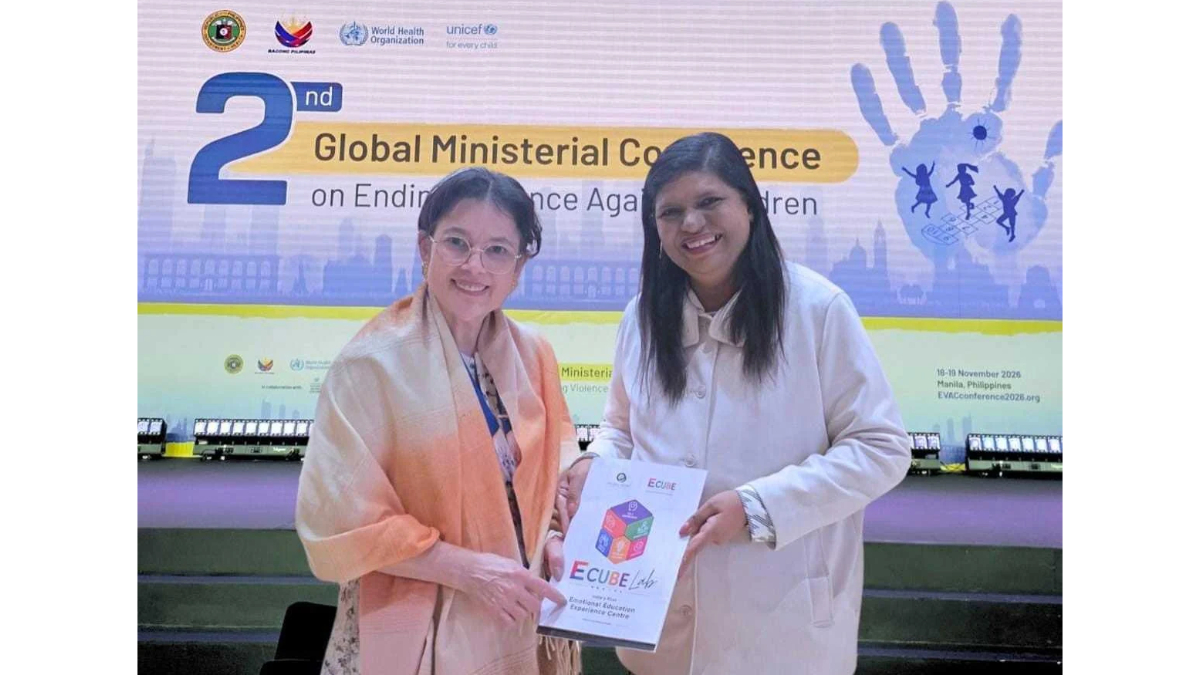
Hon. Ada María Mejía Signorelli, Minister of State for the Office of Children, Adolescence and Family, Government of Honduras, and Dr. Chinu Agarwal, Founder, Feeling Minds
New Delhi [India], November 23: Psychologist Dr. Chinu Agrawal presented India’s emotional education efforts at the Second Global Ministerial Conference on Ending Violence Against Children in Manila, held on 18 and 19 November. She attended at the invitation of the World Health Organization (WHO) and UNICEF. The conference brought together ministers, policymakers, UN representatives and child protection experts. Discussions focused on preventing violence from the outset rather than acting after an incident, including helping children become emotionally aware and capable.
- Dr. Chinu Agrawal presents India’s approach at WHO-UNICEF conference
- Protecting children from violence now depends on their emotional strength as well as on laws and safety systems. An initiative that began in Agra has won a place on the international stage.
Governments from 94 countries announced 283 commitments, covering safe homes and schools, the role of parents, mental health and stronger child protection systems.
A decade of work
Dr. Dr. Agarwal is the founder and director of Feeling Minds and founding president of the International Society for Mental Health Advocacy and Action (ISMHAA). In Manila she spoke about the organisation’s work since 2016, India’s first Emotional Education Lab and the E-Cube experiential learning model.
Feeling Minds aims to make emotional education a regular part of schooling. Students learn to recognise their feelings, manage anger and stress, understand others, communicate, resolve disputes and build healthy relationships. Through its FEEL-SEAL programme and the E-Cube lab, activities and hands-on experiences make psychology practical for children. The organisation says it has reached over 4 lakh students and trained more than 2,500 teachers.
Conversations in Manila
Dr. Agrawal discussed school-based emotional education and her working model with delegates and experts from several countries. She met United Nations Assistant Secretary-General and UNICEF Deputy Executive Director. Mr. Ted Chaiban; Dr. Daniela Ligiero, CEO of Together for Girls and the Brave Movement; and Dr. Sabine Rakotomalala, Technical Officer in WHO’s violence prevention unit. She also spoke with Philippine Cabinet Secretary Benjamin Abalos Jr., Health Secretary Dr. Edwin Mercado, Secretary of Health, Government of the Philippines, Atty. Raul T. Vasquez, Undersecretary, Department of Justice, Government of the Philippines; Nepali parliamentarian Ms.Prabha Dhakal and Hon. Ada Maria Mejia Signorelli, Honduras’ State Minister for Children, Adolescents and Family Affairs, and exchanged views with officials of the Indian delegation. From the Indian delegation, she exchanged views with Dr. Govind Kumar Bansal, Director, Maternal Health, Ministry of Health and Family Welfare, Government of India, and Dr. Rachana Kathuria, National Professional Officer, Adolescent Health, WHO India, among other officials.
The conference noted that teaching children to spot unsafe situations, speak up about their troubles, seek help and understand their boundaries is a key part of prevention. Emotional education builds these abilities. It does not replace laws, safety systems or professional mental health services, but strengthens them.
“India has a lot to offer the world,” said Dr. Agrawal, calling it an important opportunity to share the country’s efforts at the invitation of WHO and UNICEF. Keeping children safe, she said, requires safe homes, supportive schools, aware parents and emotionally intelligent communities. Telling children what is right and wrong is not enough, because they must also learn to understand their feelings and needs.
International delegates showed interest in the Feeling Minds model and the E-Cube lab in Agra. The talks also touched on knowledge exchange and possible collaboration, and on ISMHAA’s proposed Youth Mental Wellbeing Summit in Agra.
For Agra, the recognition carries particular weight: an effort that started in schools in 2016 is now part of the global conversation on child protection.
About Feeling Minds
Founded in 2016 and based in Agra, Feeling Minds works in psychology, emotional education and mental health, running experience-based training programmes for children, parents, teachers and professionals. Beyond the lab, FEEL-SEAL and E-Cube, its initiatives include school mental health programmes, teacher capacity building, parent education and professional training.
If you object to the content of this press release, please notify us at [email protected]. We will respond and rectify the situation within 24 hours.